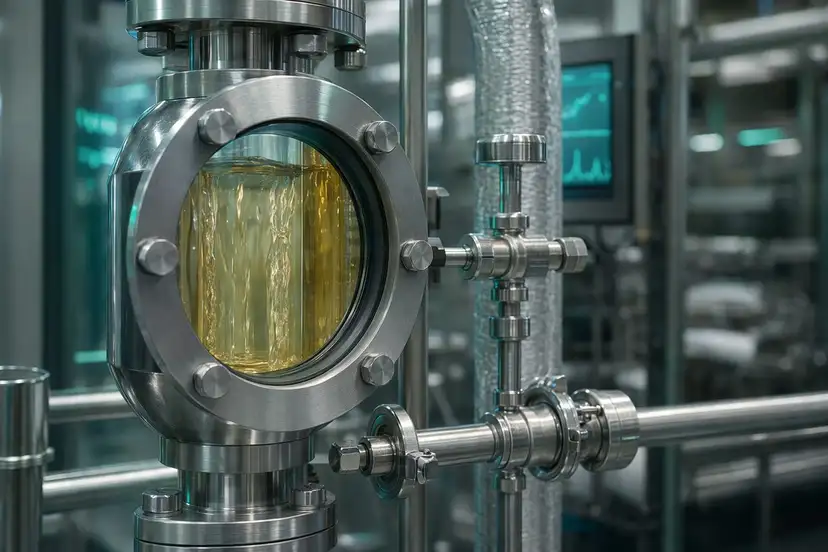
Permeate Powder, Syrup, or Fermentation Feedstock | Seraflux
Compare outlet options for whey permeate solids and see where enzyme support can improve viscosity control, fermentability, throughput, and product consistency.
Request pricing Compare outlet options for whey permeate solids and see where enzyme support can improve viscosity control, fermentability, throughput, and product consistency.
Request pricingFor a dairy whey processor, permeate is not a by-product to clear from the plant. It is a solids stream with different commercial outlets, each with its own process demands.
Powder rewards drying efficiency and stable handling. Syrup rewards concentration control and predictable viscosity. Fermentation feedstock rewards sugar accessibility, mineral management, and a clean handoff to the downstream user.
The best outlet is rarely decided by market price alone. It is decided by what the plant can run consistently: membrane capacity, evaporator load, crystallization behavior, dryer availability, storage time, transport distance, and the quality expectations of the buyer.
Seraflux supports whey processors with enzyme solutions designed around real operating conditions. As an enzyme supplier for whey processing, we focus on conversion targets, flow behavior, sensory impact, and plant-fit implementation rather than generic claims.
Before choosing between powder, syrup, or fermentation supply, map the constraint that limits value.
Is the plant constrained by evaporation or drying capacity?
Powder may offer broader market access, but it demands energy, dryer time, and tight control of crystallization and stickiness.
Is the goal to move solids with less processing cost?
Syrup can reduce drying load, but the processor must manage viscosity, microbial control, storage stability, and transport economics.
Is there a nearby fermentation buyer?
Feedstock can be attractive when logistics are short and specifications are clear, but fermentability, ash profile, inhibitor risk, and batch consistency matter.
Does the outlet tolerate variation?
Some buyers can handle changing solids profiles. Others need narrow ranges for sugar composition, conductivity, color, and sensory neutrality.
The practical question is simple: which route turns permeate solids into reliable margin without creating a new bottleneck?
Permeate powder is often the most flexible commercial format. It is easier to store, ship, and sell across multiple food and feed applications. It also gives the processor independence from local liquid buyers.
Powder production is process-intensive. Lactose behavior, mineral load, concentration level, crystallization control, and dryer balance all affect yield and handling.
If crystallization is incomplete or viscosity rises too quickly, the evaporator and dryer can become the value-limiting assets. Operators see it as longer residence time, fouling pressure, variable powder flow, and more frequent cleaning.
For selected whey and permeate streams, enzyme treatment can be used to adjust carbohydrate profiles before concentration or drying. The goal is not enzyme use for its own sake. The goal is to improve how the stream behaves through the plant and how the finished ingredient performs for the buyer.
Potential objectives include:
Seraflux helps processors evaluate whether enzyme treatment belongs before evaporation, after membrane concentration, or in a dedicated holding step based on available time, temperature window, sanitation design, and target outlet.
Permeate syrup is a practical route when the plant wants to move solids without carrying the full cost of drying. It can be a strong fit when regional customers can use liquid carbohydrate-mineral streams and when logistics are efficient.
Syrup is less forgiving than powder. Viscosity, microbial risk, storage time, temperature control, and tanker turnaround all affect margin. A syrup that is easy to pump at the plant can still become difficult for the customer if solids, mineral balance, or sugar profile varies.
Processors should define the real operating envelope:
Enzyme treatment can support syrup strategies when the commercial requirement depends on carbohydrate profile, fermentability, sweetness perception, or flow behavior.
Typical plant-level goals include:
The best enzyme program is built around the syrup’s actual use. A syrup destined for fermentation does not need the same sensory profile as a syrup used in food formulation. A syrup shipped daily has different risk than one held over a longer dispatch window.
Fermentation buyers are increasingly interested in dairy-derived carbohydrate streams. Permeate can be a useful feedstock when its sugar profile, mineral content, and handling conditions match the organism and process.
This outlet can be attractive because it may reduce drying demand and create a direct industrial channel for whey solids. But it is specification-led. Fermentation users care about repeatability.
A stream that looks acceptable on a compositional sheet can still underperform in fermentation if carbohydrate accessibility, osmotic load, or residual processing conditions vary. Fermentation customers often judge the supplier by how predictable their process becomes, not just by the delivered solids.
Enzyme treatment can be used to tailor the sugar profile toward the needs of a fermentation route. Depending on the substrate and buyer specification, this may support faster uptake, more complete conversion, or more consistent batch behavior.
Seraflux works with processors to define conversion targets that match the downstream fermentation requirement while keeping the treatment step practical for dairy operations.
Key questions include:
| Outlet | Best fit | Main plant demand | Main commercial risk | Enzyme relevance |
|---|---|---|---|---|
| Permeate powder | Broad ingredient markets and longer storage | Evaporation, crystallization, drying, powder handling | Energy cost, dryer bottlenecks, variable functionality | Carbohydrate profile control, solubility behavior, viscosity management |
| Permeate syrup | Regional users and reduced drying load | Concentration, pumping, holding, tanker dispatch | Viscosity drift, storage risk, logistics dependency | Flow behavior, fermentability, customer-specific sugar profile |
| Fermentation feedstock | Nearby industrial fermentation users | Consistent preparation and delivery | Batch variability, mineral sensitivity, uptake inconsistency | Sugar accessibility, conversion targeting, process repeatability |
No outlet is universally better. The right option is the one that fits your plant constraint, your customer base, and your quality control capability.
Start with the volume and solids profile of the permeate stream across the year. Peak whey periods often expose the real constraint. If the plant is already short on evaporation or drying capacity, a liquid or syrup route may protect throughput.
Drying cost cannot be compared with tanker cost in isolation. Powder may travel farther and store longer. Syrup may avoid dryer load but tie the plant to regional demand and tighter shipping windows.
Do not develop the stream first and find a buyer later. Powder, syrup, and fermentation feedstock each need different quality targets. Enzyme treatment should be designed against the specification that actually earns the sale.
Bench viscosity at one temperature is not enough. Consider concentration, cooling, holding time, pumping shear, and customer unloading temperature. A syrup strategy fails quickly if it cannot move cleanly.
For food and beverage outlets, enzymatic conversion must be controlled so that sweetness, color, aroma, and mouthfeel remain aligned with the buyer’s use case. More conversion is not always better.
The treatment step must fit into available tanks, heat profiles, cleaning regimes, and production scheduling. If implementation creates operator burden, the value case weakens.
Seraflux supplies enzyme solutions for whey processors that need practical control over carbohydrate conversion, viscosity, and downstream usability.
Our work typically starts with a plant conversation, not a catalogue selection.
We look at:
From there, we help define an enzyme approach that supports the outlet decision without forcing the plant into an unrealistic process window.
Enzyme treatment is most useful when the outlet depends on more than simply concentrating solids.
Consider enzyme support when you need to:
Avoid enzyme treatment when there is no defined commercial or operating target. The value comes from measurable process fit and customer acceptance.
The right question is not, “Should we make powder, syrup, or feedstock?”
The better question is:
Which outlet can our plant run consistently, and what treatment step helps us meet that specification with less friction?
That is where enzyme selection matters.
A well-matched enzyme program can help a whey processor turn a variable permeate stream into a more predictable commercial product. It can support throughput, reduce handling surprises, and give sales teams a clearer specification to take to market.
If you are evaluating permeate powder, syrup, or fermentation feedstock, Seraflux can help you assess where enzyme treatment may improve the process case.
Share your stream profile, target outlet, operating window, and commercial constraints. We will help you identify a practical route for trials and scale-up.
Request a quote using the on-site form.

Tell us your application and volume — we reply with pricing and lead time.